
Digital Product Passports for textile and apparel
Textiles are among the first product groups named under the ESPR. TrustRise collects the data a textile passport needs from the companies that actually hold it — the mill, the dyehouse, the farm — and links it to the garment you sell.
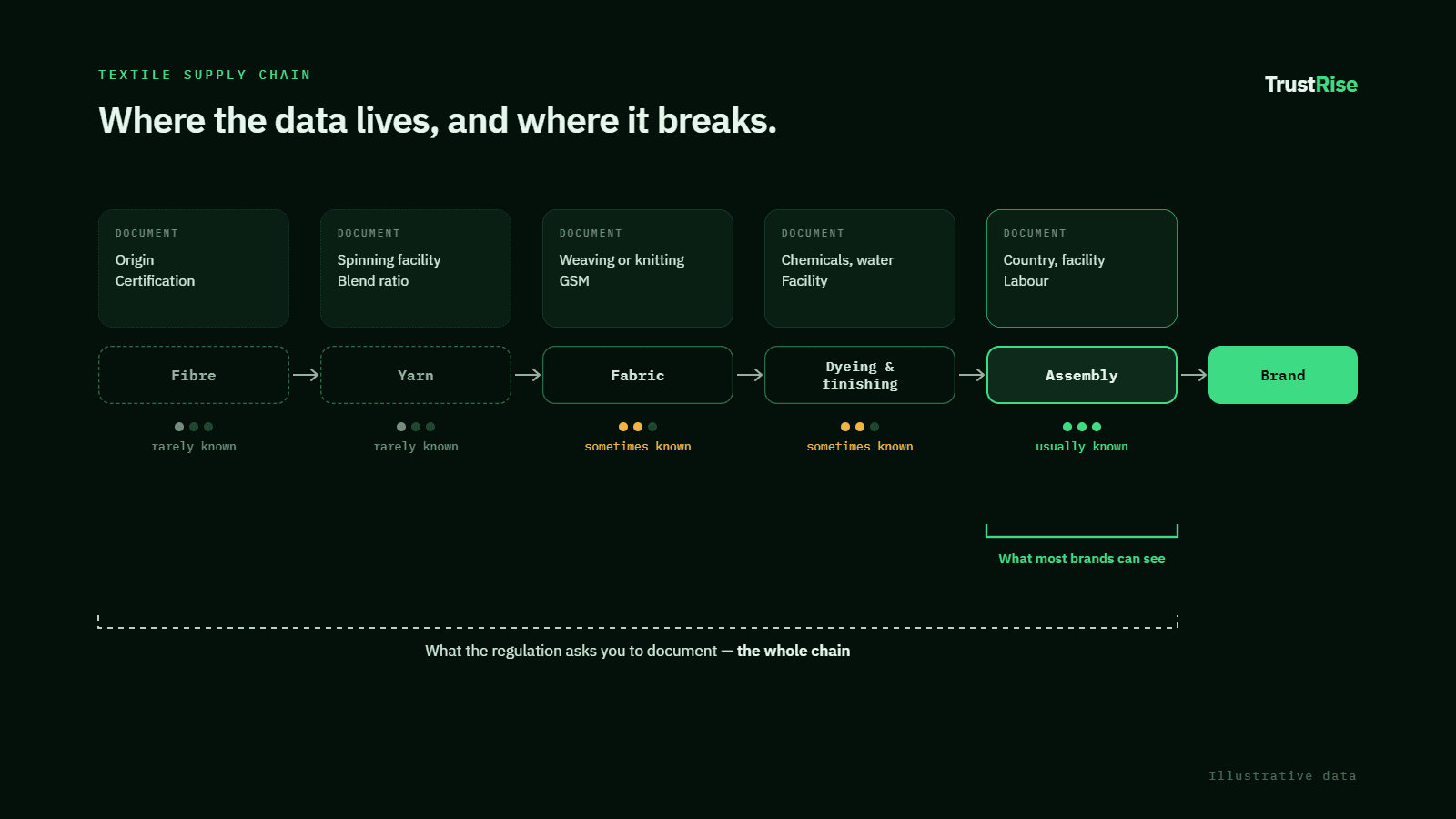
Why textiles are hard
Most brands know their assembly factory. Fewer know the mill. Almost none know the spinner, and the fibre source is usually a line on a purchase order from a company they have never spoken to.
The regulation does not care where your visibility stops. A textile passport will ask for fibre composition, origin, chemical treatment and recycled content — facts that live three or four companies upstream of your purchase order.
Closing that distance is the work. Everything else in a passport is a form.
Every step linked, with quantities that reconcile.
Composition tracked as a percentage, not a label claim.
GOTS, GRS, RWS and OEKO-TEX, with transaction certificates.
Substance declarations captured where the treatment happens.
What the delegated act is likely to require
The textile delegated act has not been adopted. The EU Working Plan gives 2027 as the indicative year for adoption, and the act applies at the earliest eighteen months after it enters into force.
But the field list is not a mystery. The Trace4Value pilot identified roughly 125 likely data points, and the JRC draft specification covers the same ground: identification, material composition, production steps and facilities, substances of concern, durability and repairability, environmental footprint, and end of life.
TrustRise is built against that specification. When the act lands, the fields will be refined — not reinvented.
Your suppliers are in the same position
A mill in Turkey, a dyehouse in Portugal, a knitter in North Macedonia: each is being asked for this data by several brands at once, in several formats, by people who have never explained why.
TrustRise gives them a free account and a structured request. They answer once and it serves every brand that asks. That is the difference between a supplier who responds in a week and one who stops reading your emails.
No charge, no contract, no plan limits on what they record.
A certificate entered once attaches to every request.
Your mill can ask their spinner without you in the middle.
Exportable at any time, not locked to your account.
Start before the deadline, not because of it
Mapping a textile chain to the fibre takes eighteen months to three years for a brand that has never done it. Suppliers do not answer quickly the first time. Certificates turn out to be missing. Quantities do not reconcile and someone has to find out why.
That timeline is the reason to start now — not the delegated act, which is years out. A brand that begins in 2026 will have a working chain when the regulation lands. A brand that begins in 2028 will be reconstructing history from invoices while paying emergency rates.
Map one product
Pick a garment with a cooperative supplier. Send one request. See what comes back and how long it takes — that tells you more about your readiness than any assessment, and it costs nothing on either side.