
ESPR timeline: what is decided and what is not
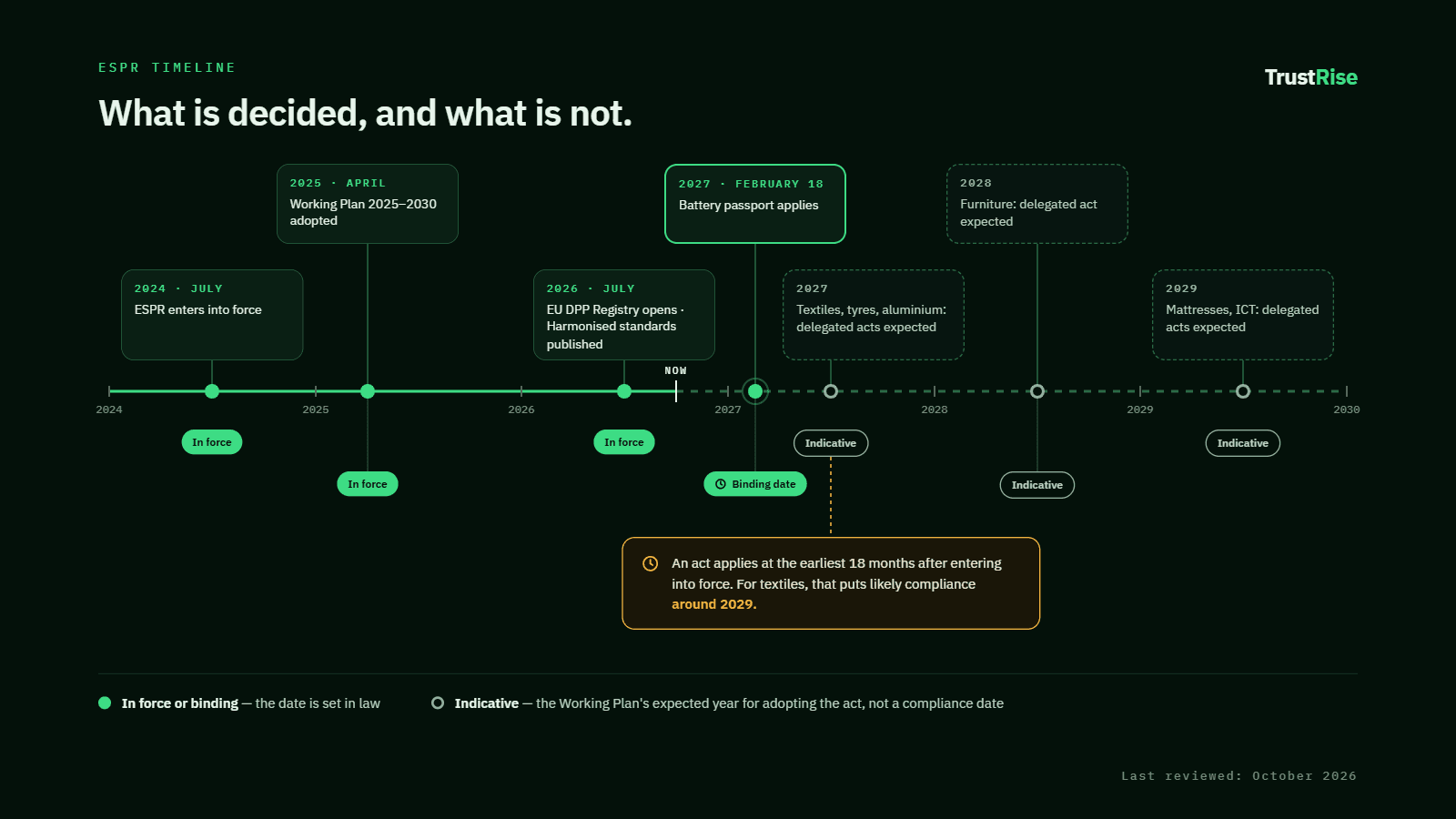
The only binding Digital Product Passport deadline today is batteries, on 18 February 2027. Everything else is an expected year for adopting a law, not a date you have to comply by.
Vendors blur that line because urgency sells. Here is the actual position, with sources.
What is already law
Regulation (EU) 2024/1781 — the ESPR — entered into force in July 2024. It is a framework: it creates the power to set product rules, but sets almost none itself.
The Working Plan 2025–2030, adopted in April 2025 as COM(2025) 187, names the first product groups and the years their delegated acts are expected. Those years are indicative, and the Commission says so.
The EU DPP Registry opened in July 2026 under Commission Implementing Regulation (EU) 2026/1778. Battery operators are its first mandatory users.
Six harmonised standards — EN 18216 to EN 18223 — were published in July 2026 under Commission Implementing Decision (EU) 2026/1736. Conformity with them creates a presumption of legal conformity under Article 41(2).
The only binding deadline
Regulation (EU) 2023/1542, Article 77, requires a digital battery passport from 18 February 2027 for industrial batteries above 2 kWh, EV batteries and light-means-of-transport batteries placed on the EU market.
That date is fixed and in force. If you make batteries, it is five months away as of late 2026.
If you make anything else, no date applies to you yet.
What is expected, and when
| Product group | Act expected | Earliest application |
|---|---|---|
| Iron and steel | 2026 | 2028 |
| Textiles, tyres, aluminium | 2027 | 2029 |
| Furniture | 2028 | 2030 |
| Mattresses, ICT | 2029 | 2031 |
The second column is the Working Plan’s indicative year for adopting the delegated act. The third applies the ESPR’s own rule that an act takes effect at the earliest eighteen months after entering into force.
Both columns can move. Treat them as planning horizons, not deadlines.
Why the real deadline is earlier
Mapping a supply chain to the raw material takes between eighteen months and three years for a company that has never done it. Suppliers do not answer quickly the first time. Certificates turn out to be missing. Quantities do not reconcile.
So the date that should govern your planning is not the act’s. It is the point at which you need a working chain — which is well before the law requires one, and considerably before your retail customers start asking, which they already are.
How we keep this current
We review this page against EUR-Lex and the Commission’s ecodesign pages each quarter, and update it when a delegated act moves. The date it was last checked appears on the diagram above.
If you find something out of date, tell us. We would rather be corrected than cited wrongly.
Check where you stand
Ten passports free, no card. Map one product and you will know how far from ready you actually are.