TrustRise logo — Digital Product Passport platform for fashion and textile brands
BLOG

What Is the EU Digital Product Passport — And Why Textile Brands Can't Wait Until 2027

From 2027, textiles sold in the EU must carry a Digital Product Passport — a QR code linking to verified data on fibres, chemicals, footprint and end of life. It isn't a label redesign; it's a supply chain data problem. Here's what the regulation actually requires, why most brands aren't ready, and the five steps to take before the deadline.

What Is the EU Digital Product Passport — And Why Textile Brands Can't Wait Until 2027
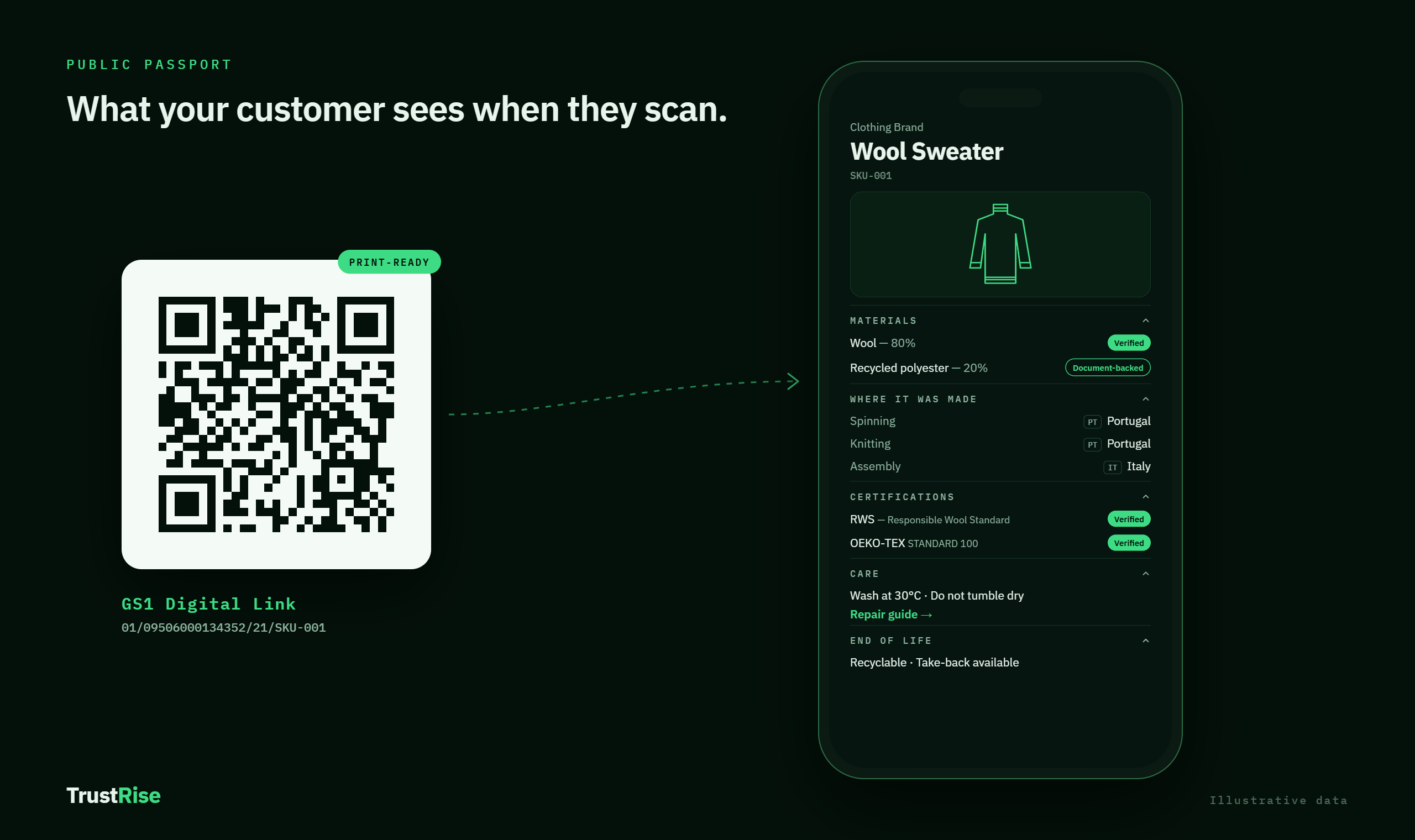
What Is the EU Digital Product Passport — And Why Textile Brands Can't Wait Until 2027 If you sell clothing in the European Union, a regulatory change is coming that will touch every product you put on a shelf. Under the Ecodesign for Sustainable Products Regulation (ESPR), textiles and apparel are among the first categories required to carry a Digital Product Passport — a structured, machine-readable record attached to each product via a data carrier such as a QR code. This isn't a label redesign. It's a data requirement, and most brands are not structurally ready for it. What a Digital Product Passport actually contains A DPP is not a marketing page. The EU's draft specification for textiles defines dozens of required data points, including: Product and manufacturer identification — who made it, where, and under which operator identifiers Fibre composition — exact percentages, including recycled and organic content by weight Chemical declarations — substances of concern, with concentration ranges Environmental impact data — carbon and environmental footprint values Durability and repairability information End-of-life guidance — recycling, take-back, disposal Certifications and conformity documentation Each field has a defined access level. Some data is public to any consumer scanning the code. Some is restricted to parties with a legitimate interest. Some is visible only to market surveillance authorities. This is where most compliance projects fail. Publishing everything is a competitive and legal risk. Publishing too little makes the passport non-compliant. The access model has to be built into the system, not bolted on afterwards. The real problem isn't the passport. It's the data behind it. Ask a brand today for the recycled content percentage of a specific production lot, backed by a valid transaction certificate, and the answer usually involves three emails and a supplier who replies next week. A passport is only as credible as its inputs. Which means DPP readiness is really a supply chain data problem: Suppliers hold the certificates — but have no system to submit them into Certificates expire — and nobody tracks it until an audit Claims like "organic cotton" are made at brand level — but evidence sits at lot level, if it exists at all Data is keyed to seasons and orders, not to the model and batch structure regulators expect Fixing this in spreadsheets doesn't scale past a handful of SKUs. How Trust Rise approaches it Trust Rise is built around the assumption that the passport is the output, and the supply chain is the system. A supplier network, not a questionnaire. Suppliers create their own accounts, connect to the brands they work with, and submit certificates, lot data and shipment records directly. Brands send requests instead of chasing documents. Lots, shipments and transaction certificates. Material flows are recorded as linked records, with validation rules on quantities, mass balance and date ordering — so the chain from fibre to finished garment can actually be followed. Claim gating. A sustainability claim can only be published when supporting evidence exists in the system. No evidence, no claim. Access control by design. Every field carries its regulatory access level. Absolute environmental values, conformity certificates and operator details are not exposed publicly simply because they're in the database. Passports that stay live. A published passport remains permanently accessible at its QR code and remains editable, with a full audit log of changes and version history — because the regulation expects the record to stay accurate for years, not to be frozen at publication. What to do before the deadline You don't need a platform to start. You need to know where you stand. Map your tier 1 suppliers. Who actually produces your garments, and do you have current contact and certification data for each? Audit your certificates. Which are valid, which have expired, which cover materials you no longer use? Check your claims. For every sustainability claim on your site and labels, ask: could you prove this at lot level tomorrow? Pick one product and try to build its passport manually. Whatever you can't fill in is your actual gap list. Then choose a system — one that connects your suppliers, not one that asks you to type their data in yourself. Brands that start now will treat the DPP as a differentiator. Brands that start in 2027 will treat it as an emergency. Start with one product Trust Rise is a Digital Product Passport platform for brands and their suppliers, built on the EU ESPR framework. It's free to start, and you can publish your first passport without a contract. Create your first passport →